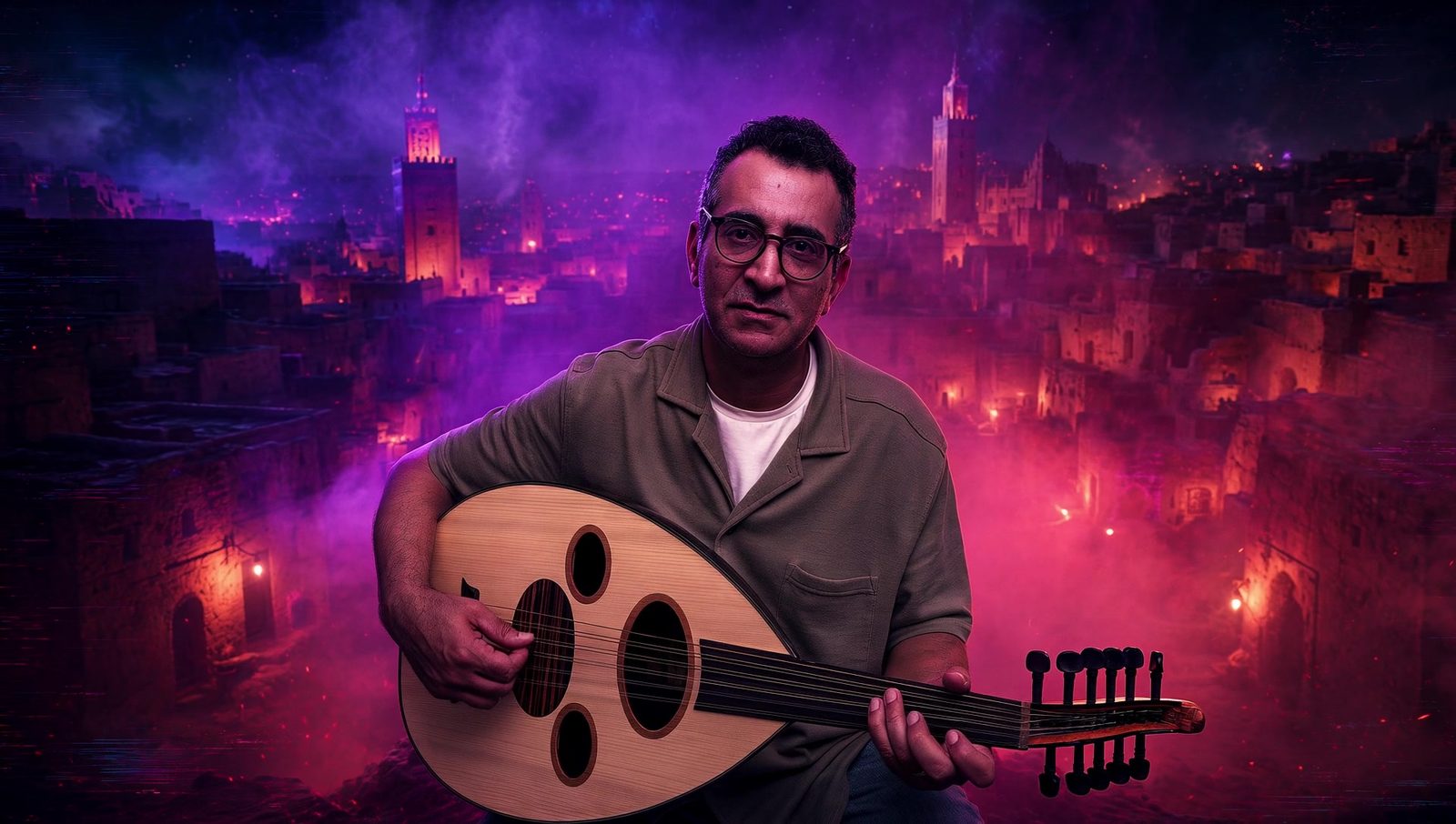
I named and catalogued Raï w-Phonk in 2026. The two words had touched before — Cheb Terro and Taymour, Rai Futura, 2022. A genre is a catalog with a definition, not a Bandcamp tag. The name says what it needs to: raï, the rebel street music of Algeria — Oran — و (w, the Derja word for "and") — phonk, the dark, bass-heavy child of Memphis rap that the internet raised. Two street musics, born forty years and five thousand miles apart, finally in the same room.
Here is the sound, plainly: the gasba — the breathy, keening reed flute of the Maghreb — playing over drill 808 slides. The cowbell is TEK in the kit, not the hook. Raï's melodic soul carrying verses written in Tunisian Derja and French, often inside the same line. And underneath it all a bass I call الباص يزلزل — the bass that quakes, Bass Zelzel — the machine, mixed to shake a car door the way a darbuka shakes a wedding.
The rhythm is the treaty
What makes the fusion hold isn't the instruments — it's the grid. North African music and Memphis phonk both live and die by percussion, and I write every verse on a rhythm cell I notate as DOM TEK-TEK DOOOM TEK: one syllable per stroke, with the long vowel stretched across the held DOOOM the way a raï singer leans into a lament. When a Darija line locks into that grid, the 808 and the darbuka stop being strangers. They were always cousins; nobody had introduced them.
The words refuse
Raï w-Phonk choruses carry a signature skeleton: a doubled call — يا زين، يا زين — a hard question — وين راح الكلام؟ (where did the talk go?) — and always, somewhere, a refusal built on Darija's negation: ما نسلموش. We don't surrender. Phonk supplies the menace; raï supplies the wound; Darija supplies the spine. I write in Tunisian Derja; raï's refusal grammar — ما...ش — is Maghrebi, and I use it because it is the fist the street already knows. The construction wraps around a verb like a fist closing.
Where it came from
I was born in Sfax, Tunisia, and I live in Pennsylvania — which means I carry both halves of this genre in my ordinary day. The heritage half: malouf on the radio of my childhood, raï cassettes, the maqams that still decide how I hear melody. The American half: the 808 pressure of the music playing in every car around me. And between the two, a classroom: ethnomusicology courses at the University of Illinois — darbuka on stage with the Balkanalia Ensemble — where the Greek rebetika taught me something I never forgot: everywhere on earth, the powerless keep inventing the same kind of music — defiant, simple, beautiful, and passed mouth to mouth. Raï is that music. Phonk is that music. For years I kept them in separate rooms. Raï w-Phonk is what happened the night I stopped.
The flag-carrier is the title track, "Rai & Phonk" — the genre's anthem, on video and everywhere I publish. The deepest cut is "Darb El Ghubar" (درب الغبار), the song I measure everything against — it opens with a dédicace, the old raï tradition of blessing your people by name, before the 808s arrive. "Ghaddara" (غدّارة) shows the genre's wounded side — betrayal at 122 BPM. And because one wing is never the whole bird: the same studio also records malouf and muwashshah, the Andalusian classical tradition of Tunisia, sung the old way. The distance between those two wings is where I live.
Why it matters
Because heritage music does not belong in a museum. The gasba survived centuries by moving — village to city, wedding to cassette, cassette to satellite. Putting it over an 808 is not a betrayal of tradition; it is the tradition: the sound moving again, to wherever the young ears are. If you make music from two worlds — whatever your two worlds are — consider this genre an open door and a standing invitation.
— Mourad Youssef Bouajaja, MYB Studio